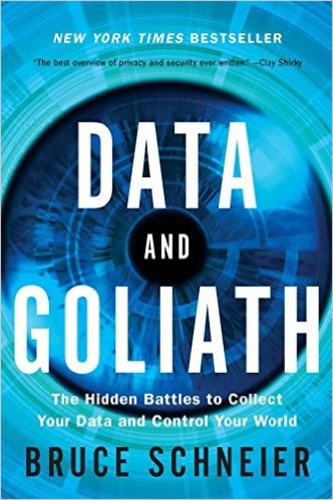
Data and Goliath: The Hidden Battles to Collect Your Data and Control Your World
If you need to be convinced that you're living in a science-fiction world, look at your cell phone. This cute, sleek, incredibly powerful tool has beacome so central to our lives that we take it for granted. It seems perfectly normal to pull this device out or your pocket, no matter where you are on the planet, and use it to talk to someone else, no matter where the person is on the planet. Yet every morning when you put your cell phone in your pocket, you're
making an implicit bargain with the carrier. "I want to make and receive mobile calls; in exchange, I allow this company to know where I am at all times. • The bargain isn't specified in any contract, but it's inherent in how
the service works- You probably hadn't thought about it, but now that I've pointed it out. you might well think it's a pretty good bargain. Cell phones really are great, and they cant work unless the cell phone companies know where you are, which means they keep you under their surveillance. This is a very intimate form of surveillance. Your phone tracks where you live and where you work. It tracks where you like to spend your weekends and evenings. It tracks how often you go to church (and which church), how much time you spend in a bar, and whether you speed when you drive. It tracks—since it knows about all the other phones in your
area—whom you spend your days with, whom you meet lunch. and ...
Data is everywhere. We create it every time we go online, turn our phones on (or off), and pay with credit cards. The data is stored, studied, and bought and sold by corporations and governments for surveillance and for control. "Foremost security expert" (Wired) and best-selling author Bruce Schneier shows how this data has led to a double-edged Internet - a Web that gives power to the people but is abused by the institutions on which those people depend.
In Data and Goliath, Schneier reveals the full extent of surveillance, censorship, and propaganda in society today, examining the risks of cybercrime, cyberterrorism, and cyberwar. He shares technological, legal, and social solutions that can help shape a more equal, private, and secure world.